
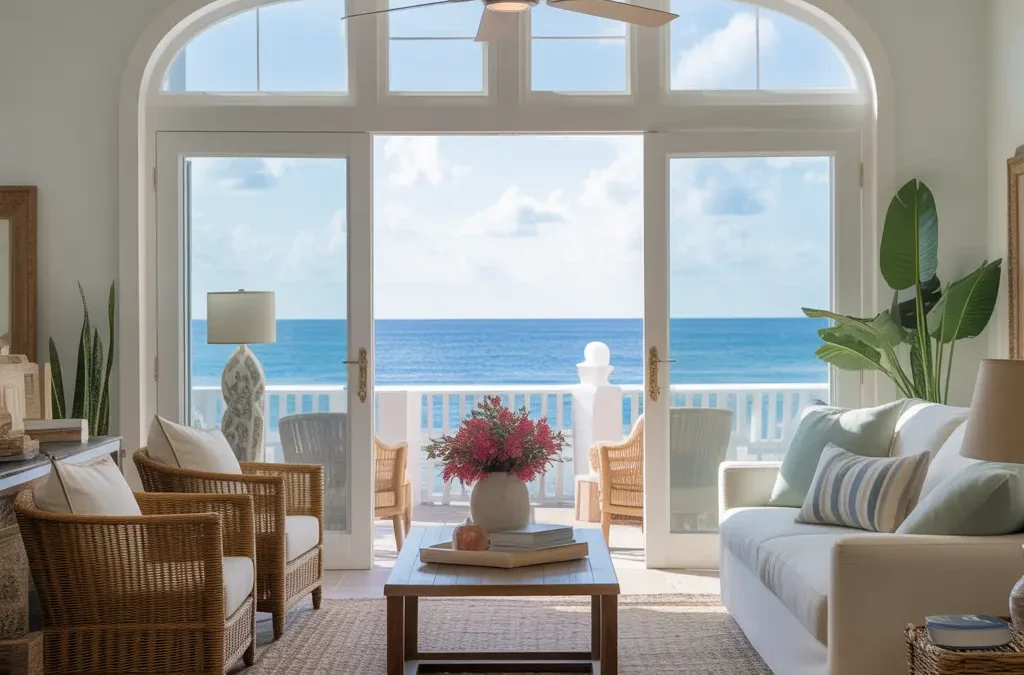
If you’ve worked on a design project anywhere along the Emerald Coast, you already know that this stretch of Florida’s Panhandle operates on its own rhythm. From spring break through Labor Day, US Highway 98 turns into a slow crawl. Beach towns double and triple their populations overnight. Vacation rentals turn over every Saturday. And the window between “the property is ready” and “the client needs it furnished” gets tighter by the year.
For interior designers managing installations across Destin, the 30A corridor, and Panama City Beach, understanding the seasonal delivery landscape isn’t a nice-to-have — it’s the difference between a smooth project and one that’s derailed before a single piece of furniture crosses the threshold. Each of these three markets has its own character, its own traffic patterns, and its own logistical quirks that experienced designers plan around from day one.
Destin: High Volume, High Traffic, High Stakes
Destin is the most commercially dense market on the Emerald Coast. With major thoroughfares, a busy harbor, heavy tourist infrastructure, and a year-round residential base that swells dramatically in summer, it also carries the most significant traffic burden of the three markets.
During peak season — Memorial Day through Labor Day — US Highway 98 through Destin becomes one of the most congested stretches of road in the Florida Panhandle. Delivery trucks navigating from the west toward Sandestin or eastward toward Miramar Beach can face significant delays that throw off carefully planned installation schedules. Access to beachfront properties and condo complexes is often further complicated by parking restrictions, elevator reservations, and building management policies that vary widely across communities.
For designers working in Destin, the practical implication is clear: peak season delivery windows require earlier coordination, more buffer time, and a logistics partner who knows the area well enough to route around bottlenecks and communicate proactively when timelines shift. Projects that would take a morning to install in October can easily consume a full day in July.
The best mitigation strategy is front-loading the logistics work. Completing receiving, inspection, and storage well in advance means the only variable on installation day is traffic — not whether all the pieces have arrived and been cleared.
30A: Narrow Roads, Architectural Complexity, and Boutique Scale
The 30A corridor is a different challenge entirely. Stretching roughly 26 miles between Inlet Beach and Miramar Beach, Scenic Highway 30A connects some of the most architecturally distinctive and high-value residential communities in the region — Rosemary Beach, Alys Beach, WaterColor, Seaside, Grayton Beach, and more.
The character of 30A — low building heights, pedestrian-scale streets, dense tree canopies, and thoughtfully designed neighborhoods — makes it a designer’s dream and a delivery driver’s challenge. Roads through many of these communities are narrow. Access points are limited. Properties in areas like Alys Beach and Rosemary Beach often have specific delivery protocols that require advance coordination with property management or HOA staff.
During season, the single-lane stretches of 30A that make it so charming in October become serious bottlenecks in June. A furniture truck trying to reach a property in Seagrove Beach on a Saturday morning during peak summer can be looking at waits that turn a planned two-hour installation into a full-day affair.
Designers working on 30A projects benefit enormously from scheduling installation days on weekdays, avoiding Saturday turnovers entirely, and working with a logistics partner who has direct experience navigating these communities — not someone figuring it out for the first time in a loaded truck on a summer morning.
Panama City Beach: Scale, Access, and Off-Season Opportunity
Panama City Beach occupies a different position in the market. More commercially developed than 30A, more affordable in its real estate profile, and with a broader range of property types — from high-rise condo towers to sprawling Gulf-front estates — PCB presents its own set of logistical considerations.
High-rise condominium deliveries require freight elevator coordination, building management approvals, and often strict time windows that can’t be missed. The Front Beach Road corridor is a different kind of congested during spring break and peak summer than Destin or 30A, and navigating it with a large delivery vehicle requires local knowledge and a plan.
However, PCB also offers one of the more underutilized advantages on the Emerald Coast: a genuinely productive off-season delivery window. From October through February, traffic is light, properties are accessible, and installation teams can move efficiently through even complex multi-unit projects. Designers furnishing vacation rental inventories or completing renovation projects in this market do themselves a real service by targeting fall and winter installation dates whenever the client’s timeline allows.
What Every Designer Should Build Into Their Timeline
Across all three markets, a few principles hold regardless of season. First, never count on delivery directly to a project site without a reliable storage and staging solution in place. Vendor shipments arrive on vendor timelines, not yours, and the Emerald Coast doesn’t offer the luxury of holding pieces in a garage or unconditioned space without consequence.
Second, Interior Design Logistics support from a team that knows these markets locally is worth every dollar. A partner who understands that a Rosemary Beach delivery on a Saturday in August is a different operation than one in November — and plans accordingly — protects your project, your timeline, and your client relationships.
Third, build more time into your installation schedule than you think you need during peak season. The Emerald Coast is one of the most visited stretches of coastline in the Southeast. That popularity is great for the vacation rental market your clients are investing in. It’s less great for a fully loaded delivery truck trying to get down a narrow 30A street at 9 a.m. on a Tuesday in July.
The designers who work most effectively in this region are the ones who treat logistics as a core part of the creative process — not an afterthought. Pairing your design vision with the right Moving & Storage partner means your work arrives on time, in perfect condition, and gets installed exactly the way you planned it, regardless of the season.